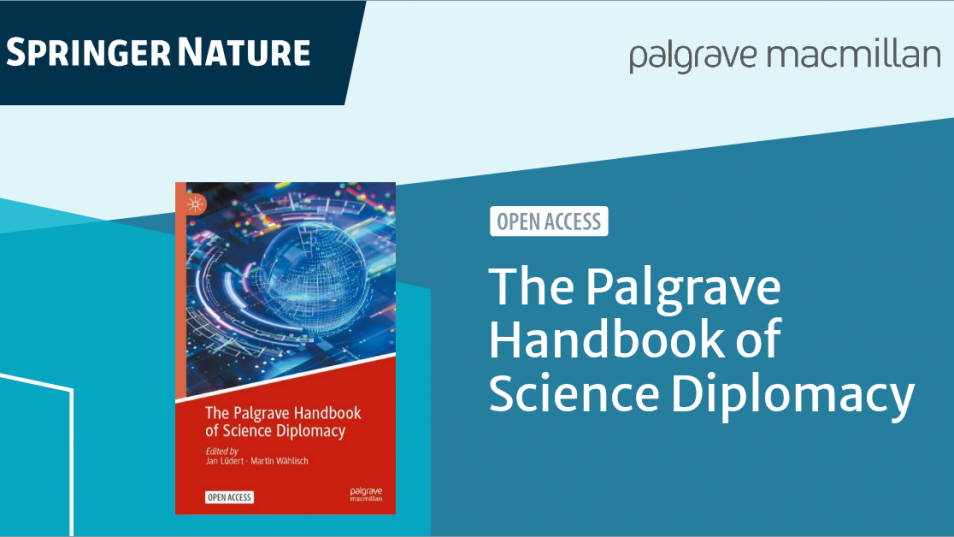
Tha Palgrave Handbook of Science Diplomacy
About the Book
This handbook examines the transformation of science diplomacy in an era defined by geopolitical rivalry, rapid technological change, and contested global governance. Moving beyond traditional notions of science diplomacy as a cooperative, state-led endeavor, the volume advances a polycentric framework that captures a more complex reality of a fragmented landscape in which authority, expertise, and infrastructure are distributed across states, international organizations, corporations, universities, and transnational networks. At its core, the book argues that science diplomacy is no longer primarily about fostering collaboration, but about governing the conditions under which collaboration remains possible, legitimate, and resilient. Contributions explore how emerging technologies such as artificial intelligence, biotechnology, and quantum computing intensify competition while simultaneously requiring cross-border cooperation. They also examine how non-state actors, private platforms, and subnational entities increasingly shape agendas, standards, and access to knowledge.
Structured across conceptual, empirical, and forward-looking sections, the handbook combines theoretical innovation with practice-oriented case studies. It highlights key trends including the securitization of science, the rise of new diplomatic actors, and the growing importance of technological infrastructures as sites of power. Throughout, authors interrogate the trade-offs between openness and security, inclusion and control, and innovation and governance. By reframing science diplomacy as a problem of institutional design and interface governance, this volume offers a timely and rigorous guide for scholars, practitioners, and policymakers seeking to navigate cooperation under conditions of uncertainty, asymmetry, and disruption.
How the Handbook Came About
The idea for the Palgrave Handbook of Science Diplomacy emerged from a growing sense that science diplomacy was entering a new phase. Rapid technological change, intensifying geopolitical competition, and shifting patterns of international cooperation were raising new questions about how science, technology, and diplomacy interact and about whether established approaches were still sufficient to understand them.
When the call for chapters was launched in 2024, the response far exceeded expectations. Researchers and practitioners from across disciplines, institutions, and countries proposed contributions examining science diplomacy from a wide range of perspectives. Over the following two years, these contributions developed into a collective effort bringing together scholars, diplomats, policymakers, and science diplomacy practitioners.
An important milestone in this process was the DWIH New York 2024 FUTURE FORUM, Science Diplomacy in an Era of Technological Disruption, hosted at the Johns Hopkins Science Diplomacy Hub in Washington, D.C. The forum created an opportunity for contributors and experts to meet in person, discuss emerging chapters and case studies, and explore many of the questions that ultimately shaped the volume.
The project was supported from its earliest stages by the German Academic Exchange Service (DAAD) and made possible through funding from the German Federal Foreign Office. Together with the contributions of more than 50 authors and experts, as well as the guidance of reviewers, colleagues, and the team at Palgrave Macmillan, these conversations evolved into the handbook published today.
Endorsement 1
“This Handbook on Science Diplomacy is timely and makes an important contribution to current debates and deliberations in a rapidly changing world to realise the hope and opportunity that science brings to ensure a sustainable future for many generations to come. It brings together the voices from an impressive range of scholars and practitioners at the coalface of the intersection of science, technology, diplomacy, and international cooperation.”
—Quarraisha Abdool Karim, President of the The World Academy of Sciences
Endorsement 2
“At the end of the first quarter of the 21st century, science, technology, economic, security and geopolitical interests are more intertwined than ever. In this context, as science and technology undergo fundamental evolution alongside a complex and changing geopolitical landscape, the interaction between science and diplomacy must also evolve. This volume of conceptual and illustrative essays should be of value to both scholars and practitioners of the evolving discipline of science diplomacy.”
—Sir Peter Gluckman, President of the International Science Council
Endorsement 3
“There has never been a more important time to advance science diplomacy. This authoritative volume offers a critical reframe for our times and will provide a vital handbook for the disrupted years ahead.”
—Dame Juliet A. Gerrard, Professor at the University of Auckland and former Chief Science Advisor to the Prime Minister of New Zealand
Endorsement 4
“Scientific knowledge keeps expanding at an ever faster pace, and diplomacy needs to keep up: knowledge has always been a source of power, and in an era of intensifying geopolitical competition, it can lead to new conflicts as well as to deeper cooperation. This handbook is an indispensable guide for all those who want to understand the diplomacy of the future.”
—Jean-Marie Guehenno, former UN Under-Secretary-General and Arnold A. Saltzman Professor of Political Practice at Columbia University
Endorsement 5
“This work makes the powerful case that scientific trust, integrity and collaboration provide a unique foundation for harmonious international relations. The book is rich in examples and learnings from practical experience. It describes success factors that provide a blueprint for individual researchers, science agencies and governments wishing to build enduring bridges through science diplomacy.”
—John Stocker, former Chief Scientist of Australia and former
Chief Executive of the Commonwealth Scientific and Industrial
Research Organisation (CSIRO)
Endorsement 6
“With statecraft on the decline globally, the Handbook on Science Diplomacy is a timely guide to navigating global fragmentation and technological disruption. It powerfully demonstrates how science diplomacy can advance cooperation, build much-needed trust, and address shared challenges in a highly polarized world.”
—Moneef R. Zou’bi, Science Advisor to the InterAction Council
Endorsement 7
“This is a timely and well-crafted volume that takes seriously how science diplomacy is being reshaped by technological disruption and geopolitical competition. By advancing an analytically innovative polycentric perspective, the editors and contributors recast science diplomacy as a problem of governing distributed authority, expertise, and infrastructure, moving decisively beyond abstract calls for cooperation. It will be an important and widely used reference for scholars and practitioners working at the intersection of science, technology, and diplomacy.”
–Corneliu Bjola, Professor of Digital Diplomacy at the University of Oxford
Endorsement 8
“This handbook is a timely publication. Only a few years ago, science diplomacy promised solutions to global crises such as climate change and pandemics. Today, geopolitical upheavals, above all Russia’s invasion of Ukraine, and technological disruptions driven by AI have posed entirely new challenges to the field. In this context, risk management has become a central academic concern. The chapters of this handbook identify current risks and discuss ways to address them, from ensuring the transparency, reproducibility, and universal validity of scientific knowledge to fostering trust in science and legitimating scientific advice to governments. In essence, this is a matter of redefining the conditions for international scientific cooperation. This handbook will be an essential tool for those wishing to sustain hope in scientific rationality in the face of an emerging martial and confrontational multipolar world order.”
—Carola Sachse, Professor Emerita of Contemporary
History at the University of Vienna
Endorsement 9
“In our present moment, reflection and action on the circulation, governance, and engagement of science are not only timely but unavoidable. Science diplomacy’s polyhedral character has deepened into a form of complexity that generates both heightened tensions and significant potential – perhaps even the possibility of contributing to the making of a different future. This handbook contributes to these debates by bringing together a diverse range of voices that attend to the multiplicity of actors and organisations shaping the field.”
–Barbara Silva, Associate Professor at the Pontifical Catholic
University of Chile
Endorsement 10
“In an era where global challenges demand creative, cross-border solutions, the Handbook of Science Diplomacy is a welcome, necessary resource for leaders committed to advancing international relationships. This volume offers a timely and rigorous guide to navigating the complexities of science diplomacy, highlighting how strategic partnerships and network-building can drive impactful research and innovation across geopolitical divides. The actionable insights and case studies provided will help institutions to build resilient, inclusive, forward-looking collaborations to address the world’s most pressing issues.”
—Annette Gray, Interim Vice Provost for Research at New York University
Endorsement 11
“This important handbook affirms that science diplomacy is strongest when grounded in political neutrality, methodological rigor, and intellectual independence. It demonstrates how scientists and researchers can contribute constructively to world affairs without compromising the credibility that gives science its public value.”
—Alexander S. Preker, President and CEO, Health Investment and
Financing Director, USA Healthcare Alliance Adjunct Assistant
Professor, Columbia University Adjunct Assistant Professor, Icahn
School of Medicine at Mount Sinai, New York, Former Chief
Economist for Health, World Bank Former Head of Health
Investment Policy, International Finance Corporation
Endorsment 12
“Geopolitical, social, and technological changes are currently reshaping the relationship between science and politics in the field of international cooperation. This anthology provides a comprehensive overview of the debate surrounding the concept of science diplomacy and offers new perspectives on what science diplomacy can and should be in our multipolar world.”
—Sven Werkmeister, Director of Strategy at German
Academic Exchange Service (DAAD)
Endorsement 13
“The international context of science diplomacy has changed dramatically during the past couple of decades, from one of unfettered globalization to one of geopolitical strategic rivalry in a multipolar world of influence and mistrust. This dramatic shift requires a deep rethinking of the objectives, analytical lens, and tools of science diplomacy as well as of the actors engaging in it. This book does exactly that quite skillfully by blending multiple perspectives and a wide array of themes. It is a must read for those interested in the new style of hardened polycentric science diplomacy in an era of technological disruption.”
—Nicholas Vonortas, Associate Dean of Research at the Elliott School
of International Affairs, The George Washington University
Endorsement 14
“A great paradox of our moment is that advances in science and technology, and our responses to them, have made international cooperation both more urgent and more fragile. The shared epistemic ground we have sought is fractured and authority has been redistributed in ways that resist traditional governance. This book confronts our predicament with unusual clarity. By reframing science diplomacy not as idealized bridge-building but as practical interface governance—asking how the linkages among infrastructure, authority, and expertise can be designed to keep cooperation legitimate and resilient—it provides material to create a new framework for action. When the credibility of claims, methods, and risk frames is itself contested, new conditions for cooperation must be constructed with sober acceptance of a multiplicity of rival perspectives and aims. This handbook shows us how.”
—Jeff Seul, Lecturer on Law, Harvard Law School, Lecturer on the Practice
of Peace, Harvard Divinity School, Co-chair, Peace Appeal Foundation,
Partner and Chair, Technology and Telecommunications Industry
Sector Group, Holland & Knight LLP
Endorsement 15
“I have to say this collection is like a work of art – insightful, deep and comprehensive. At last someone has tackled a complex subject and made it understandable. It fills a significant gap in our collective knowledge.”
—Charles Landry, International Adviser on the Future of Cities; Author
and Speaker; Founder of Comedia; Co-founder of the Creative Bureaucracy
Festival; Developer of the “Creative City” concept